Research
The Watanabe Group studies the universal structure of quantum many-body systems through the unifying lens of symmetry. We work primarily on the foundations and consequences of symmetry-related phenomena in condensed matter physics — from spontaneous symmetry breaking and topological phases to the rigorous mathematical structure of quantum lattice models. Our work combines rigorous theory (proofs of general theorems, no-go results, and bounds) with broadly applicable frameworks (such as symmetry indicators usable across all 230 crystallographic space groups) and occasional predictions for real materials. Our current research spans six interconnected directions, summarized below.
1. Spontaneous symmetry breaking and Nambu–Goldstone bosons
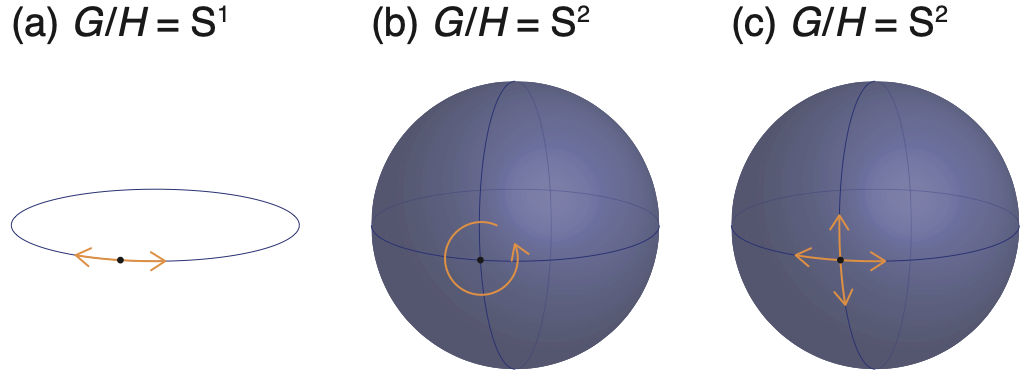
Whenever a continuous symmetry is spontaneously broken, gapless excitations called Nambu–Goldstone (NG) bosons appear. The classic theorem of Goldstone counts one mode per broken symmetry generator. In nonrelativistic systems — where most condensed matter realizations live — the count and dispersion of NG modes can deviate dramatically from this classic picture: ferromagnetic magnons are quadratic, not linear; some symmetries break without producing the "expected" number of modes.
We established a unified counting rule that resolves these long-standing puzzles (PRL 108, 251602 (2012); PRX 4, 031057 (2014); reviewed in Annu. Rev. Condens. Matter Phys. 11, 169 (2020)). We also proved the absence of quantum time crystals in equilibrium (PRL 114, 251603 (2015)), showing that translation symmetry in time cannot be spontaneously broken in a ground state or in equilibrium states.
Recent work has uncovered surprises that test the limits of these theorems — including a one-dimensional spin model that breaks a continuous $U(1)$ symmetry at zero temperature, a remarkable counterexample to common expectations from the Mermin–Wagner theorem (PRL 133, 176001 (2024), Editors' Suggestion).
Press releases and related coverage
Selected press releases for this theme:
- "Discovery of a one-dimensional spin model exhibiting spontaneous breaking of continuous symmetry — a new counterexample to the Mermin–Wagner theorem" (Oct 25, 2024)
- "Rigorous proof of the impossibility of time crystals" (Jun 22, 2015)
- "Theorem unifies superfluids and other weird materials", UC Berkeley News (Jun 8, 2012)
Related commentary and feature articles:
- "Time crystals: the search for a new phase of matter", Physics World (Apr 4, 2022)
- "Quantum computer shows that time crystals are phases of matter", Physics World (Dec 1, 2021)
- "Eternal Change for No Energy: A Time Crystal Finally Made Real", Quanta Magazine (Jul 30, 2021)
- "Could These Crystals Help Us Travel Through Time?", Popular Mechanics (Feb 11, 2020)
- "A new, theoretical type of time crystal could run without outside help", Science News (Nov 27, 2019)
- Theory of time crystals (republications of a University of Exeter release):
- "New twist in quest to develop understanding of time crystalline behavior", Phys.org (Nov 21, 2019)
- "New twist in quest to develop understanding of time crystalline behavior", EurekAlert! (Nov 21, 2019)
- "New twist in quest to develop understanding of time crystalline behavior", ScienceDaily (Nov 23, 2019)
- "In search of time crystals", Physics World (Jul 17, 2018)
- "This Physicist Turned Time Crystals From a Theoretical Oddity to an Odd Reality", VICE / Motherboard (Jan 11, 2018)
- Experiments on nonequilibrium time crystals (republications of a Harvard University release):
- "Physicists create time crystals: New form of matter may hold key to developing quantum machines", Phys.org (Apr 17, 2017)
- "Creating time crystals", ScienceDaily (Apr 17, 2017)
- "Time crystals: what are they?", Prospect (Mar 17, 2017)
- Nature News (2017)
- "The Quest to Crystallize Time", Scientific American (2017)
- "Scientists Finally Observed Time Crystals—But What the Hell Are They?", Gizmodo (2017)
- "Time Crystals!", PBS Space Time (Mar 15, 2017)
- "Physicists propose new definition of time crystals—then prove such things don't exist", Phys.org (Jul 2015)
- Journal Club for Condensed Matter Physics (Sep 2014)
- "Theory Explains the Quantum Weirdness of Exotic Materials", WIRED (Jun 18, 2012)
- Unified theory of Nambu–Goldstone bosons (republications of a UC Berkeley release):
- "Theorem unifies superfluids and other weird materials", Phys.org (Jun 11, 2012)
- "Theorem unifies superfluids and other weird materials", EurekAlert! (Jun 8, 2012)
- APS Physics Synopsis (2012)
2. Topological phases and symmetry indicators
The discovery of topological insulators turned the classification of insulating band structures into a central question of condensed matter physics. We developed a symmetry-based framework that diagnoses the topology of any band insulator using only the symmetry representations of its Bloch wavefunctions. This framework covers all 230 nonmagnetic and 1651 magnetic space groups (Nat. Commun. 8, 50 (2017); Sci. Adv. 4, eaat8685 (2018)) and extends to topological superconductors in all space groups (Sci. Adv. 6, eaaz8367 (2020)). We also clarified the notion of fragile topology — phases that resist a Wannier description yet are not in the usual topological-insulator class (PRL 121, 126402 (2018), Editors' Suggestion).
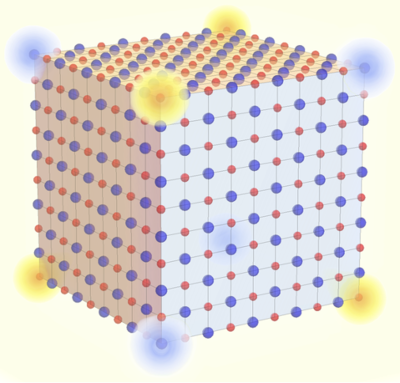
The same circle of ideas led to a striking concrete prediction: the corners of a finite NaCl crystal carry a fractional charge of $\pm e/8$ (PRX 11, 041064 (2021)) — a higher-order topological phenomenon hiding in everyday salt. On the materials side, we have driven high-throughput searches for topological superconductors (PRL 129, 027001 (2022), Editors' Suggestion).
Press releases and related coverage
Selected press releases for this theme:
- "Bulk-edge correspondence in measurement-induced topological phases" (Jun 19, 2025)
- "A new database for systematic exploration of topological superconductors" (Jul 7, 2022)
- "Theoretical demonstration that NaCl crystal corners carry fractional charge" (Jan 4, 2022)
- "Symmetry-based diagnosis of topological superconductors" (May 1, 2020)
- "Discovery of a new class of insulators between trivial and topological" (Sep 17, 2018)
- "Theoretical clarification of a new type of topological insulator" (Sep 17, 2018)
- "Discovery of symmetry-based indicators of band topology" (Jul 2, 2017)
Related commentary and feature articles:
- Fractional corner charges in NaCl (HKUST release and republications):
- "HKUST Co-led Study Reveals Topology at the Corner of the Dining Table", HKUST (Jan 30, 2022)
- "Study reveals topology at the corner of the dining table", Phys.org (Jan 28, 2022)
- "Topology at the corner of the dining table", ScienceDaily (Jan 31, 2022)
- Finding topological materials using symmetry indicators (Harvard Gazette article and republications):
- "Identifying exotic properties", Harvard Gazette (Apr 16, 2019)
- "Scientists develop way to identify topological materials", Phys.org (Apr 17, 2019)
- "Scientists Develop Way to Identify Topological Materials", Lab Manager (Apr 17, 2019)
- Band structures in magnetic space groups (republications of a Harvard University release):
- "Breaking down band structures—system could help researchers design new materials with specific properties", Phys.org (Aug 22, 2018)
- "Design new materials with specific properties: Breaking down band structures", ScienceDaily (Aug 22, 2018)
- Journal Club for Condensed Matter Physics (Aug 2017)
3. Nonlinear electromagnetic responses in superconductors
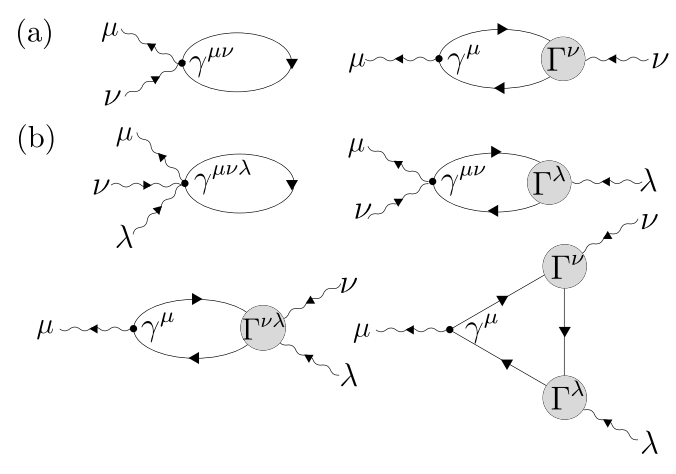
Recent terahertz experiments have made it possible to observe the nonlinear optical responses of superconductors — including third-harmonic generation, which has been interpreted as a signature of the elusive Higgs mode. Constructing a microscopic theory of these responses is, however, surprisingly subtle: naive perturbative formulas spuriously violate gauge invariance, and the contributions of collective modes (Higgs, Nambu–Goldstone) and quasiparticles must be disentangled.
We have developed a gauge-invariant formulation of nonlinear optical responses in BCS superconductors (arXiv:2410.18679; arXiv:2501.13722) and derived rigorous f-sum rules that constrain nonlinear optical conductivities at all orders (Phys. Rev. B 102, 165137 (2020)). Most recently, we have quantified the role of quantum geometry in the competition between Higgs modes and quasiparticles in third-harmonic generation (Phys. Rev. B 114, 074508 (2026)).
4. Frustration-free quantum many-body systems
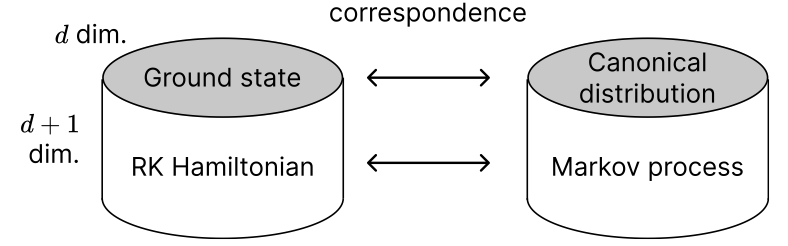
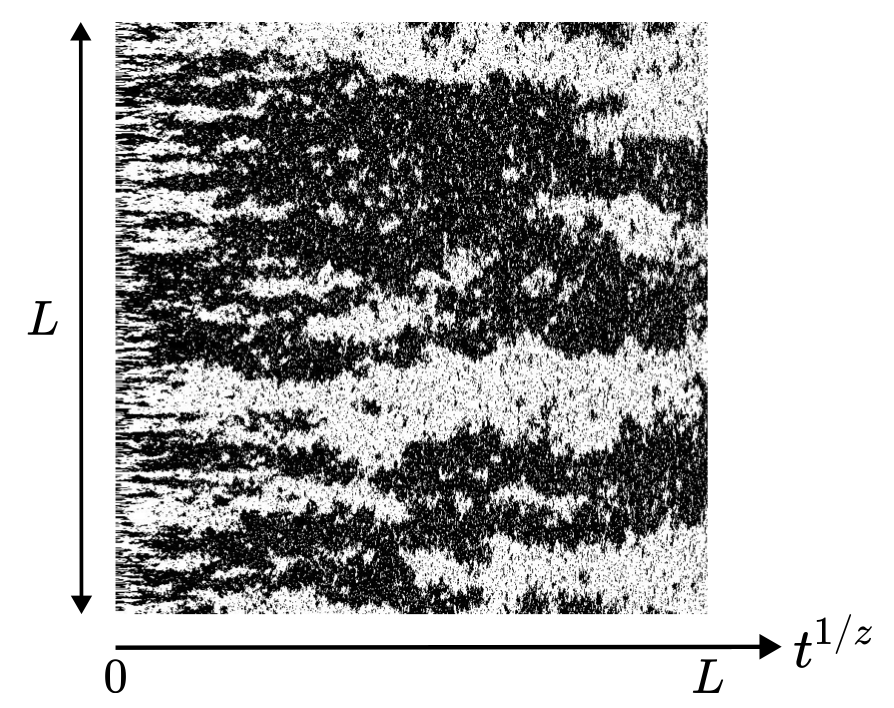
Many of the most famous models of strongly correlated physics — the AKLT chain, the toric code, Rokhsar–Kivelson dimer models, stabilizer codes — share a common mathematical structure: they are frustration-free. Each local term in the Hamiltonian is simultaneously minimized by the ground state. This special structure makes such models analytically tractable while still hosting an extraordinarily rich variety of phases (symmetry-protected, topologically ordered, fracton, …).
We are working out the general theory of gapless frustration-free systems, deriving rigorous bounds on dynamical critical exponents and finite-size gaps. Highlights include: a proof that the dynamical critical exponent must satisfy $z \geq 2$ in any gapless frustration-free system (Phys. Rev. X 15, 041050 (2025); PRB 110, 195140 (2024)), and an analogous rigorous bound for the classical Ising model that resolves a 100-year-old question about its dynamical universality class (J. Stat. Phys. 192, 76 (2025)). We have also been mapping out the landscape of frustration-free free-fermion systems (PRB 112, 115104 (2025); PRB 113, 195120 (2026); Phys. Rev. Res. 8, 023171 (2026)).
Press releases and related coverage
Selected press releases for this theme:
5. Spin ice and water-ice phases
Liquid water and water vapor — though they look very different at atmospheric pressure — are not in fact distinct phases of matter: by going around the critical point, one can be transformed continuously into the other without ever crossing a phase transition. They are merely two faces of a single phase.
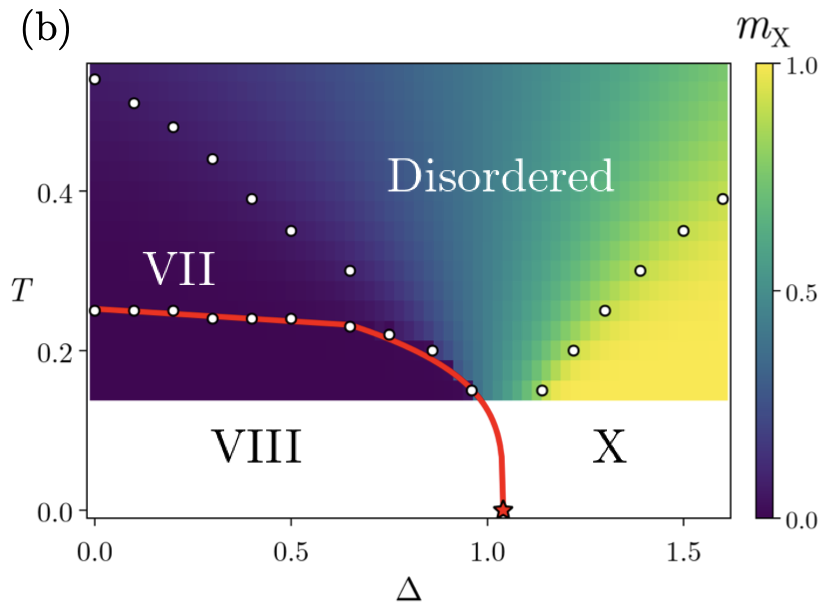
This invites a striking question for high-pressure water ice. Among its many known phases, ice VII and ice X share the same crystallographic symmetry, while ice VIII has a different one. Could VII and X then be the same phase, connected by a continuous crossover — just as liquid and vapor are?
A recent model study by our group answers this affirmatively. In a microscopic lattice model of water ice, phases VII and X are continuously connected through the screening of magnetic-monopole-like proton defects, while ice VIII, with its distinct symmetry, remains separated by a genuine phase transition (Phys. Rev. B 114, 094108 (2026)).
This raises a deeper, more general question that drives much of our work in this direction: within finite-temperature phases of identical symmetry, can there exist finer distinctions — analogous to the topological-phase classifications that exist at zero temperature — that survive thermal fluctuations and remain meaningful as classifying labels? We pursue this question in parallel through pyrochlore spin ice, where the ground-state "ice rules" are mathematically identical to those governing the proton arrangements in water ice and host emergent gauge fields, fractionalized excitations (magnetic monopoles), and topological order. Recent works classify topological phase transitions of pyrochlore spin ice for arbitrary spin $S$ and uncover dualities relating seemingly different models (arXiv:2603.03852; Phys. Rev. X 16, 041016 (2026)).
Together, these projects aim to bring the modern toolkit of topology and statistical field theory to bear on materials and questions that have been studied for over a century.
Press releases and related coverage
HKUST press release:
- "HKUST Researchers Redraw the Boundary between Phases of Matter", HKUST (Oct 14, 2026)
Related coverage:
- Spin-ice and high-pressure water-ice phases (coverage and republications based on the HKUST release of Oct 14, 2026):
- "New framework links magnetic phase boundaries to string-like defects in spin ice", Phys.org (Oct 14, 2026)
- "HKUST researchers redraw the boundary between phases of matter", EurekAlert! (Oct 14, 2026)
- "Researchers Redraw Boundaries Between Phases of Matter", Mirage News (Oct 14, 2026)
- "HKUST researchers redraw the boundary between phases of matter", BrightSurf (Oct 14, 2026)
- "New Theory Draws the Line Between Phases of Matter, From Spin Ice to High-Pressure Ice", Scienmag (Oct 14, 2026)
- "New Theory Draws the Line Between Phases of Matter, From Spin Ice to High-Pressure Ice", Bioengineer.org (Oct 14, 2026)
6. Topological phases at finite temperature

At zero temperature, topological phases provide distinctions that cannot be explained by symmetry breaking alone. Can such distinctions persist between thermal equilibrium states with the same microscopic symmetries, even when thermal fluctuations continually create defects? We study this question through the phase classification of thermal mixed states, or Gibbs states.
Our model is the three-dimensional toric code in transverse and longitudinal fields, which explicitly break both microscopic higher-form symmetries. Connected correlations between distant winding Wilson loops, measured after local error correction, reveal global information obscured by thermal fluctuations. By optimizing the observables and recovery operations, we construct an invariant and prove that it is constant within phases defined by two-way conversion through local quantum channels.
Quantum Monte Carlo calculations suggest that a phase distinct from product states of independent spins persists over a finite region of low temperatures and weak fields. Combining a rigorous invariant with numerical calculations, this work investigates finite-temperature phase distinctions beyond microscopic symmetry breaking.
Two complementary studies extend this approach to a class of classical $\mathbb{Z}_2$ lattice gauge models, including the magnetic sector of the three-dimensional toric code. The first proves that the free-energy density is analytic in temperature and perturbation strength within a sufficiently low-temperature, weak-perturbation region, even when local perturbations break the internal or gauge symmetries or introduce quantum interactions. A separate expansion establishes an analytic high-temperature region. These results prove thermodynamic stability in the controlled regions and support the conjecture that a thermal transition continues to separate low and high temperatures without symmetry protection.
The second study proves stability of the states under two-way conversion by local quantum channels. In sufficiently low-temperature, weak-perturbation domains, states remain equivalent to a reference ensemble retaining nonlocal winding information. At sufficiently high temperatures, they are instead equivalent to a product state. An optimized winding-correlation invariant takes values $\mathcal{F}_m=1$ and $0$ in these controlled regions, rigorously distinguishing two mixed-state phases without symmetry protection. These sufficient domains do not determine the full phase diagram.
H. Watanabe, Gibbs-state phases beyond microscopic symmetry breaking: A phase invariant for the 3D toric code, arXiv:2607.00134 (2026).
S. Sengoku, W. Cao, and H. Watanabe, Thermodynamic Stability of Classical $\mathbb{Z}_2$ Lattice Gauge Models, arXiv:2610.27938 (2026).
G. Xun, W. Cao, and H. Watanabe, Local-Channel Stability of Classical $\mathbb{Z}_2$ Lattice Gauge Models, arXiv:2610.27939 (2026).